
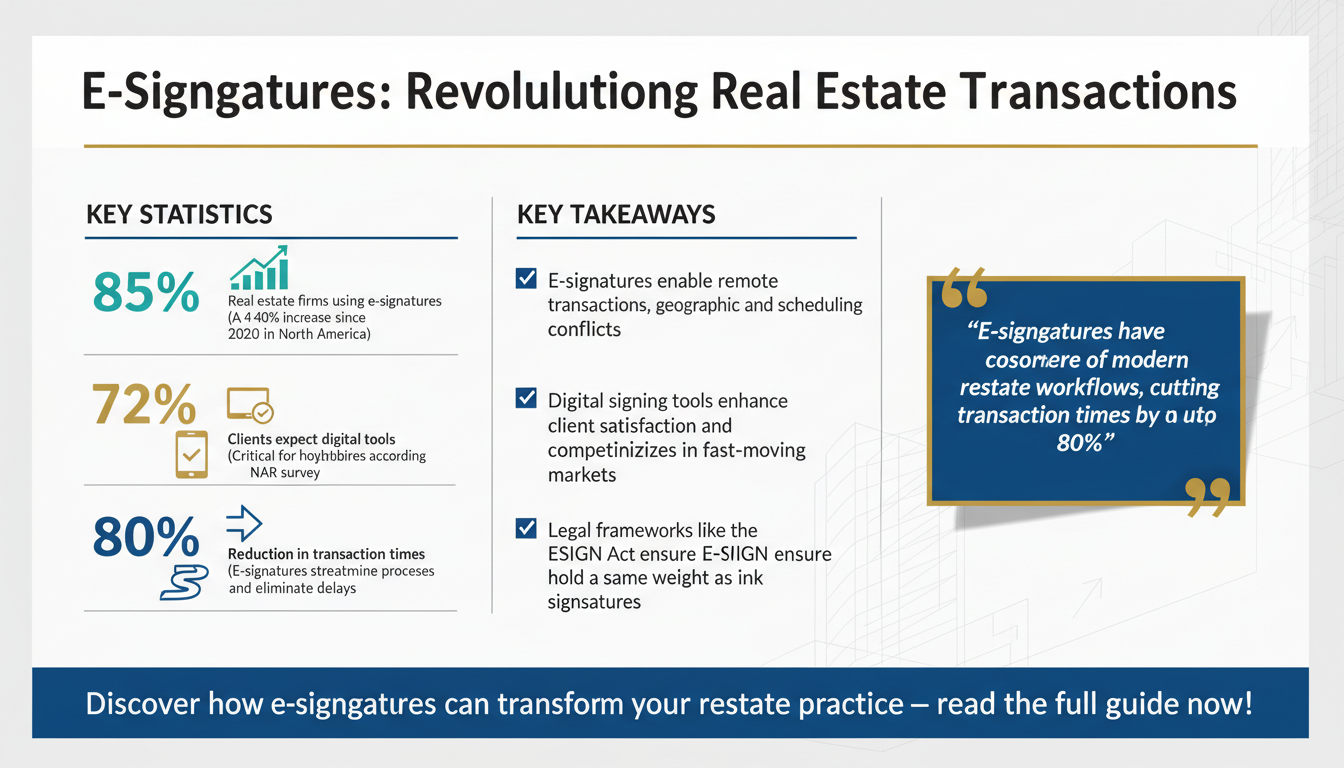
The real estate industry has seen an unprecedented transformation over the past decade, fueled by advancements in technology and the increasing demand for faster, more efficient processes. Among the most impactful innovations is the rise of electronic signatures (e-signatures), which have redefined how transactions are conducted. E-signatures have moved from being a convenience to being a cornerstone of modern real estate workflows, helping agents and brokers close deals more quickly, enhance client satisfaction, and maintain regulatory compliance.
Today, e-signatures are a must-have tool for any real estate professional aiming to stay competitive. From eliminating mountains of paperwork to enabling remote transactions, this technology streamlines processes that once took days or even weeks to complete. This comprehensive guide will delve into how e-signatures are transforming real estate transactions, providing actionable insights, examples, and strategies for agents and brokers to integrate this technology seamlessly into their practices. Whether you’re a veteran agent or new to the business, this guide will equip you with the knowledge and tools necessary to thrive in an increasingly digital industry.
1. The Rise of E-Signatures in Real Estate: A Paradigm Shift
The adoption of electronic signatures in real estate has skyrocketed in recent years, and for good reason. According to a Forrester study, 85% of real estate firms in North America now use e-signature solutions—a 40% increase since 2020. This rapid growth is driven by three primary factors: the need for efficiency, rising client expectations, and evolving regulatory environments.
Efficiency: Eliminating Bottlenecks
Traditional real estate transactions are often bogged down by inefficiencies. Paperwork must be printed, signed, scanned, and sometimes physically mailed or couriered to different parties. This process is not only time-consuming but also prone to errors, such as missing signatures or incorrect dates. E-signatures eliminate these bottlenecks entirely by digitizing the signing process. For instance, a buyer in California can sign a purchase agreement for a property in Texas within minutes, avoiding delays caused by geography or scheduling conflicts. The ability to sign documents electronically has reduced transaction times by up to 80%, according to industry reports.
Consider a scenario where multiple parties are involved in a transaction, such as buyers, sellers, agents, and attorneys. Coordinating signatures for each party can take days or even weeks. E-signature platforms streamline this process by allowing all parties to sign documents concurrently, ensuring that the transaction moves forward without unnecessary delays.
Meeting Client Expectations
Today’s real estate clients increasingly expect a seamless, digital-first experience. A National Association of Realtors (NAR) survey found that 72% of homebuyers consider digital tools critical when interacting with agents. Clients appreciate the convenience of signing documents from their phones or computers, without needing to schedule in-person meetings. Furthermore, the ability to finalize agreements quickly can make or break deals in competitive markets where speed is essential.
For example, in a hot housing market, a delay in signing an offer could mean losing out to another buyer. E-signatures enable clients to act quickly, giving them a competitive edge. Additionally, by offering digital signing options, agents demonstrate that they are tech-savvy and aligned with modern client expectations, which can enhance their credibility and attract more business.
Regulatory Support
The legal foundation for e-signatures is stronger than ever, thanks to frameworks like the U.S. ESIGN Act and the European eIDAS Regulation. These laws confirm that e-signatures carry the same legal weight as traditional ink signatures, provided specific conditions are met, such as identity verification and consent. This regulatory clarity gives agents and brokers the confidence to adopt e-signatures without fear of legal complications.
Additionally, the COVID-19 pandemic accelerated the need for remote solutions, further cementing the role of e-signatures in real estate. With social distancing measures and travel restrictions in place, e-signatures became a lifeline for keeping transactions moving forward. Even as restrictions eased, many agents and clients continued to prefer the convenience and efficiency of digital transactions, solidifying e-signatures as a permanent fixture in the industry.
 ESIGN Act, eIDAS Regulation, and COVID-19 adoption surge." class="w-full rounded-lg shadow-md" />
Pro Tip: Stay Ahead of the Curve
Agents and brokers who embrace e-signatures now position themselves as forward-thinking professionals. Consider integrating e-signatures with other digital tools, such as customer relationship management (CRM) systems and virtual home tours, to create an end-to-end digital experience for clients.
Key Takeaway
- E-signatures have become indispensable in real estate, driven by efficiency gains, client demand, and regulatory support.
- Adopting e-signatures can reduce transaction times by up to 80%, enhancing both operational efficiency and client satisfaction.
2. How E-Signatures Work: The Technology Behind the Transformation
E-signature technology is both sophisticated and user-friendly, making it accessible to professionals across industries. At its core, e-signature platforms leverage cryptographic algorithms to ensure that a digital signature is secure, verifiable, and tamper-proof. Let’s break down the process in more detail:
Step 1: Document Preparation
The first step involves uploading the necessary documents—such as purchase agreements, lease contracts, or disclosure forms—into a secure e-signature platform. The platform allows agents to prepare the document by specifying signature fields, initials, dates, and timestamps. Advanced platforms also offer pre-designed templates for commonly used forms, saving time and ensuring consistency.
For instance, platforms like DocuSign and Adobe Sign include libraries of real estate-specific templates, such as buyer representation agreements and disclosure statements. These templates are preformatted with signature and date fields, reducing the likelihood of errors and ensuring compliance with industry standards.
Step 2: Authentication
To maintain legal validity, the platform verifies the signer’s identity using robust methods. Common authentication techniques include two-factor authentication (2FA), email or SMS verification, and even biometric methods like fingerprint or facial recognition. This step is crucial for preventing fraud and ensuring that only authorized individuals can sign the document.
In high-stakes transactions, advanced authentication methods such as knowledge-based authentication (KBA) may be employed. KBA prompts the signer to answer security questions based on publicly available information, adding an extra layer of security to the process.
Step 3: Signing
Once authenticated, the signer receives an email invitation to review and sign the document. Most platforms offer a simple, intuitive interface where users can click to sign or draw their signature using a touchscreen or stylus. For transactions requiring multiple signers, the platform automatically routes the document to each party in the correct order, ensuring a smooth workflow.
Some platforms also allow for real-time collaboration, enabling all parties to review and make comments on the document before signing. This feature is particularly useful in complex transactions involving multiple revisions.
Step 4: Encryption and Storage
After the document is signed, it is encrypted and securely stored on the platform. An audit trail is also generated, documenting every interaction with the document, including who signed, when, and from which IP address. This audit trail provides a robust layer of transparency and legal defensibility.
Platforms often integrate with cloud storage solutions like Google Drive or Dropbox, making it easy to organize and access signed documents. Some also offer built-in analytics tools for tracking document status and performance metrics.

Expert Insight: Leveraging Automation
"Automating repetitive tasks like document preparation and routing can save agents hours each week," says John Milner, a technology consultant specializing in real estate. "Look for platforms that offer integrations with your CRM and transaction management software for a truly seamless experience."
Key Takeaway
- E-signature platforms use cryptographic algorithms to ensure security and compliance.
- An audit trail provides transparency and legal defensibility for every transaction.
3. Legal Considerations for E-Signatures in Real Estate
Despite their convenience, e-signatures must adhere to specific legal requirements to be considered valid. Understanding the nuances of these regulations is essential for real estate professionals looking to maintain compliance.
The ESIGN Act
Enacted in 2000, the U.S. ESIGN Act establishes that electronic signatures are legally valid if:
- Both parties consent to use electronic signatures.
- The platform provides a clear audit trail documenting the signing process.
- The signer’s identity can be authenticated through secure methods.
Consent is a critical component of the ESIGN Act. Agents should ensure that clients are fully informed about the use of e-signatures and obtain their explicit agreement before proceeding. This can be done through a checkbox or digital acknowledgment during the signing process.
The eIDAS Regulation
In the European Union, the eIDAS Regulation outlines three levels of electronic signatures: simple, advanced, and qualified. While simple e-signatures suffice for most real estate transactions, high-value or complex agreements may require advanced or qualified e-signatures, which involve stricter identity verification processes.
Advanced e-signatures are particularly valuable in cross-border transactions, where different jurisdictions may have varying legal requirements. Qualified e-signatures, which require certification by a trusted service provider, offer the highest level of security and are legally equivalent to handwritten signatures in all EU member states.
Jurisdiction-Specific Requirements
Agents should also be aware of state or local laws that may impose additional requirements. For example, some U.S. states mandate notarization for certain real estate documents. In such cases, remote online notarization (RON) solutions can be integrated with e-signature platforms to meet this requirement.
In Canada, the Personal Information Protection and Electronic Documents Act (PIPEDA) governs the use of e-signatures, requiring organizations to implement measures for data protection and consent. Familiarizing yourself with these regional regulations can help you avoid potential legal pitfalls.

Pro Tip: Consult Legal Experts
Before implementing e-signatures, consult with a real estate attorney to ensure that your processes comply with all relevant laws and regulations. Regular audits of your e-signature practices can also help you stay ahead of any legal changes.
Key Takeaway
- Familiarize yourself with the ESIGN Act and eIDAS Regulation to ensure compliance.
- Use advanced or qualified e-signatures for high-value transactions that require heightened security.
4. Step-by-Step Guide to Implementing E-Signatures in Your Workflow
Successfully integrating e-signatures into your real estate workflow involves careful planning and execution. Here’s a step-by-step guide to help you get started:
Step 1: Choose the Right Platform
Not all e-signature platforms are created equal. When selecting a solution, prioritize platforms that offer real estate-specific features, such as integration with MLS systems, customizable templates, and robust compliance tools. Platforms like Zignature are designed with these needs in mind.
Additionally, consider the platform’s scalability. If you work in a growing brokerage, opt for a solution that can accommodate an increasing number of users and transactions without compromising performance.
Step 2: Train Your Team
Proper training is essential to ensure that your agents and support staff can use the platform effectively. Focus on key functionalities like document preparation, authentication, and audit trail management. Many e-signature providers offer training resources, such as webinars, tutorials, and dedicated customer support.
Encourage team members to share feedback on the platform’s usability and identify any pain points. This collaborative approach can help you tailor training sessions to address specific needs.
Step 3: Educate Clients
Clients may have concerns about the security or legality of e-signatures. Take the time to educate them about the benefits, such as convenience, speed, and compliance with legal standards. Providing an FAQ document or a short video tutorial can help address common questions and build trust.
For example, explain how e-signature platforms use encryption to protect sensitive information and how audit trails ensure transparency. By proactively addressing concerns, you can improve client confidence and facilitate smoother transactions.
Step 4: Monitor and Optimize
Track metrics like transaction times, client satisfaction, and error rates to measure the impact of e-signatures. Use this data to refine your workflows and address any areas for improvement. Regularly review your platform’s updates and new features to ensure you’re leveraging its full potential.

Pro Tip: Start with Pilot Projects
If you’re hesitant to adopt e-signatures across your entire workflow, start with a pilot project. Choose a few transactions to test the platform, gather feedback, and make adjustments before rolling it out organization-wide.
Key Takeaway
- Choosing the right platform and training your team are critical first steps.
- Client education can help overcome resistance to adopting e-signatures.
5. Common Misconceptions About E-Signatures in Real Estate
Despite their growing popularity, several misconceptions about e-signatures persist. Let’s address and debunk some of these myths:
Myth 1: E-Signatures Aren’t Secure
E-signatures are more secure than traditional signatures, thanks to encryption, authentication, and detailed audit trails. Unlike ink signatures, which can be easily forged, e-signatures are backed by advanced technologies that make tampering nearly impossible.
Myth 2: They’re Only for Simple Transactions
E-signatures are versatile enough for even the most complex real estate deals, including multi-party agreements and international transactions. For example, platforms like DocuSign enable simultaneous signing by multiple parties across different time zones, making them ideal for global real estate deals.
Myth 3: They Lack Legal Validity
As discussed earlier, e-signatures are legally binding under most jurisdictions, provided they meet regulatory requirements. In fact, the detailed audit trail generated by e-signature platforms often provides stronger legal defensibility than traditional signatures.
Pro Tip: Educate Your Clients
Some clients may be resistant to using e-signatures due to misconceptions. Take the time to explain how the technology works and provide examples of its successful use in real estate.
Key Takeaway
- Addressing these misconceptions is essential for driving adoption among agents and clients.
6. Real-World Success Stories: E-Signatures in Action
Consider the example of a national real estate agency that implemented e-signatures across all its branches. Before adopting this technology, the average transaction time was 30 days. Post-implementation, the agency reduced this to just 10 days, resulting in a 67% improvement in efficiency. Additionally, client satisfaction scores increased by 20%, as buyers and sellers appreciated the speed and convenience of the process.
Another example comes from a boutique brokerage specializing in luxury properties. By integrating e-signatures with remote online notarization (RON), they facilitated a $10 million transaction for an international client who couldn’t travel due to visa restrictions. The seamless digital process not only impressed the client but also earned the brokerage referrals and repeat business.
Pro Tip: Highlight Your Success
Share success stories with prospective clients to demonstrate the efficiency and reliability of your processes. Testimonials and case studies can be powerful tools for building trust and credibility.
7. Measuring the ROI of E-Signatures in Real Estate
Implementing e-signatures can result in significant cost savings. By reducing paperwork, courier fees, and administrative overhead, agents often see a 50% reduction in operational costs. Additionally, faster transaction times translate into quicker commission payouts, enhancing overall profitability.
To measure ROI, track key metrics such as transaction time, error rates, and client satisfaction. Compare these metrics before and after implementing e-signatures to quantify the impact. For example, if your average transaction time decreases from 30 days to 15 days, you can calculate the additional revenue generated by closing deals faster.
Checklist: Evaluating ROI
- Track transaction times and compare them pre- and post-implementation.
- Calculate cost savings from reduced paper and courier expenses.
- Survey clients to gauge satisfaction and identify areas for improvement.
- Analyze the impact on agent productivity and deal volume.
8. Future Trends: What’s Next for E-Signatures in Real Estate?
The future of e-signatures lies in AI integration and blockchain technology. AI can automate document preparation and error checking, while blockchain offers immutable records for enhanced security and transparency.
For example, AI-powered platforms can identify missing fields in documents or flag inconsistencies, reducing the risk of errors. Blockchain, on the other hand, can create a decentralized ledger of transactions, providing an additional layer of trust and security.
Pro Tip: Stay Informed
Keep an eye on emerging technologies and consider how they can be integrated into your workflow. Early adoption of innovations like AI and blockchain can give you a competitive edge.
FAQ: Common Questions About E-Signatures in Real Estate
Q: Are e-signatures legally binding?
A: Yes, provided they comply with regulations like the ESIGN Act or eIDAS.
Q: Can e-signatures be used for notarized documents?
A: Yes, through remote online notarization (RON) solutions.
Q: How secure are e-signature platforms?
A: Most platforms use encryption, authentication, and audit trails to ensure security.
To further enhance your digital workflows, explore our sister platforms: Apparatuz for workflow automation, Applicantz for recruitment management, Schedly for scheduling and appointments, Supportly for customer support, and Zatisfied for feedback management. Together, these tools create a comprehensive ecosystem that complements your digital signature strategy.