
The rapid globalization of business has amplified the need for efficient, secure, and legally compliant methods to execute agreements. In this landscape, electronic signatures (e-signatures) have emerged as an indispensable tool for small and medium-sized businesses (SMBs) and enterprises alike. They streamline workflows, reduce costs, and significantly cut down the time it takes to execute agreements, especially when dealing with international partners. However, the legal validity of e-signatures isn't universal—it depends on understanding and complying with regulations, technologies, and best practices specific to each jurisdiction.
In this comprehensive guide, we’ll delve deep into how to create legally binding e-signatures for international agreements. Whether you're a small business owner embarking on cross-border deals or a multinational enterprise managing complex global transactions, this resource will provide the insights, strategies, and tools you need to ensure compliance and efficiency.
Understanding What Makes E-Signatures Legally Binding
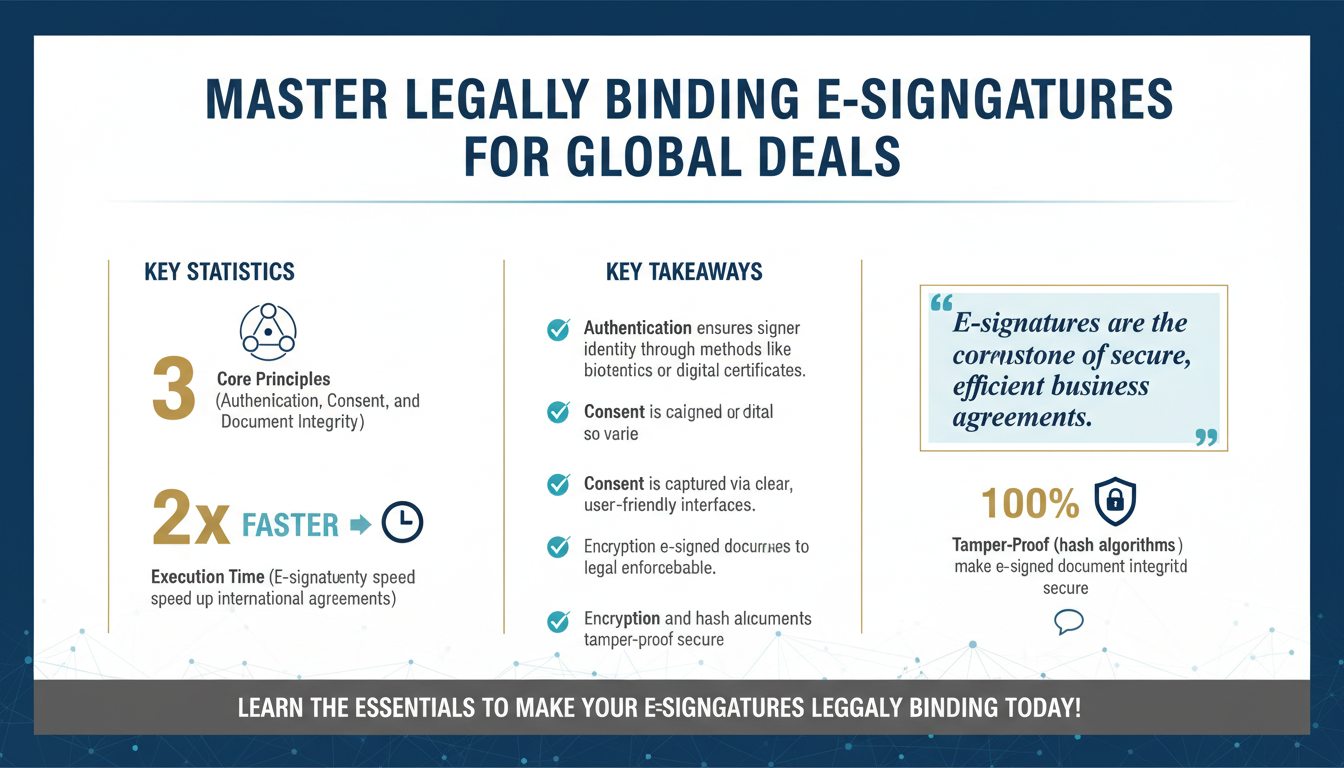
One of the most pressing questions businesses face when adopting e-signatures is: what makes them legally binding? Although the specific requirements vary across jurisdictions, there are universal principles that underpin the legal validity of e-signatures. These principles include authentication, consent, and document integrity.

The Core Principles of Legally Binding E-Signatures
1. Authentication: This involves verifying the identity of the signer. In most jurisdictions, this can be achieved using methods such as secure login credentials, multi-factor authentication, or biometric verification (e.g., fingerprint or facial recognition). For example, a company in the U.S. might require employees to use a two-factor authentication app alongside a password to validate their identities when signing documents. Similarly, in the EU, businesses leveraging Qualified Electronic Signatures (QES) often rely on digital certificates issued by trusted service providers to authenticate signers.
Authentication methods have evolved significantly in recent years. Beyond the traditional password-based systems, advanced technologies like blockchain-based ID verification and decentralized identity systems are gaining traction. These technologies provide an immutable and highly secure way to authenticate a signer, further enhancing the reliability of e-signatures.
2. Consent: Explicit consent from all parties is a cornerstone of e-signature legality. It ensures that all participants agree to the terms of the document and the use of electronic signatures for the transaction. This consent is typically captured through well-designed user interfaces. For example, many platforms incorporate checkboxes or pop-up notifications requiring signers to confirm their agreement before proceeding. Such measures not only enhance legal enforceability but also improve the user experience by making the process transparent and straightforward.
3. Document Integrity: Ensuring the integrity of a signed document is paramount. Technologies like encryption, digital certificates, and hash algorithms are commonly used to make documents tamper-proof. For instance, a hash function generates a unique digital fingerprint of the document. If even a single character is altered post-signature, the hash value changes, indicating tampering. These measures are particularly important in industries like banking and healthcare, where maintaining the integrity of sensitive documents is non-negotiable.
Global Frameworks Governing E-Signatures
Several international frameworks offer guidelines for the use and legal recognition of e-signatures:
- EU’s eIDAS Regulation: This regulation categorizes e-signatures into three levels—simple, advanced, and qualified. Qualified Electronic Signatures (QES) carry the same legal weight as handwritten signatures across EU member states.
- U.S. ESIGN Act: This act grants e-signatures the same legal status as traditional wet signatures, provided they meet certain criteria like intent and consent.
For example, under the eIDAS Regulation, a Qualified Electronic Signature is created using a qualified signature creation device and is backed by a certificate issued by a trusted service provider. This makes QES one of the most robust forms of e-signatures for cross-border agreements within the EU.
Real-World Application: An Enterprise Case Study
Consider the case of GlobalTech Solutions, a multinational corporation based in the U.S. with operations in the EU. GlobalTech adopted an e-signature platform that supports QES to comply with the eIDAS Regulation. By integrating this platform into their contract management system, they reduced their cross-border agreement processing time by 40%, while ensuring full compliance with local laws.
Actionable Tips:
- Use advanced authentication methods, such as multi-factor authentication or biometric verification, to strengthen signer identification.
- Leverage tamper-proof technologies like encryption and audit trails to ensure document integrity.
- Familiarize yourself with the legal frameworks applicable in your target markets, such as the eIDAS Regulation and ESIGN Act.
Expert Insight
"The key to making e-signatures legally binding lies in understanding the intersection of technology and law. Businesses should not only focus on meeting legal standards but also invest in technologies that future-proof their digital transactions." – Sarah Bennett, Legal Tech Consultant
International Regulations for E-Signatures: A Breakdown
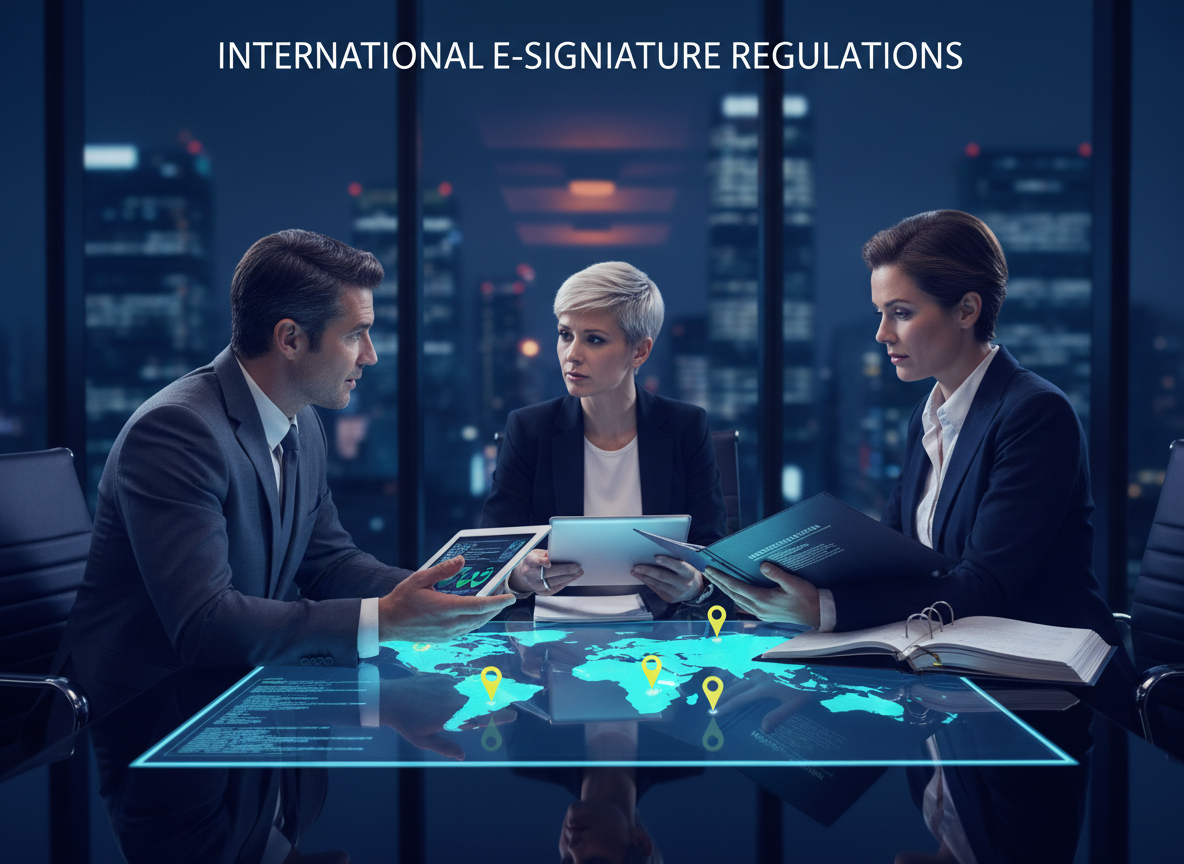
Compliance with international e-signature laws is critical for businesses operating across borders. While electronic signatures are recognized in most countries, the specific legal requirements often vary. Below, we break down the key regulations by region to help you navigate this complex landscape.
North America
United States: The ESIGN Act and the Uniform Electronic Transactions Act (UETA) govern e-signatures, granting them the same legal standing as handwritten signatures. However, certain exceptions exist, such as wills, trusts, and court orders. For example, a real estate company in California must ensure that their e-signature processes meet UETA guidelines when managing property sales agreements.
Additionally, many states have their own nuances when it comes to e-signature laws. For instance, New York’s Electronic Signatures and Records Act (ESRA) provides additional guidelines for electronic records, which can impact how businesses operate within the state. Companies need to be aware of these localized regulations to avoid any compliance gaps.
Canada: Under the Personal Information Protection and Electronic Documents Act (PIPEDA), e-signatures are recognized, provided they demonstrate consent and reliability. For instance, a telecommunications company in Toronto might use secure e-signature software to obtain customer consent for service contracts. Canada’s legal framework also emphasizes the importance of ensuring that the electronic signature process is as reliable as a handwritten signature for the given context, adding an extra layer of scrutiny for businesses to consider.
Europe
European Union: The eIDAS Regulation offers a harmonized framework for electronic signatures across EU member states. Qualified Electronic Signatures (QES) are considered equivalent to handwritten signatures. For businesses operating in multiple EU countries, adopting a QES-enabled platform ensures legal compliance.
United Kingdom: Post-Brexit, the UK follows eIDAS principles through its Electronic Identification and Trust Services for Electronic Transactions Regulations. Minor amendments have been made to tailor the framework to UK-specific needs, but the core principles remain intact. For instance, UK businesses may need slightly different certifications for QES compared to their EU counterparts, which could affect how agreements are executed.
Asia-Pacific
China: The Electronic Signature Law of the PRC recognizes e-signatures, provided they reliably identify the signer and ensure document integrity. For example, a manufacturing company in Shanghai might use e-signature software integrated with digital certificates to finalize supplier agreements.
The Chinese government has also introduced additional certifications that vendors must obtain to be considered compliant. For instance, electronic signature platforms must be approved by the local Ministry of Industry and Information Technology (MIIT) to be legally valid in the jurisdiction.
Australia: The Electronic Transactions Act 1999 recognizes e-signatures, as long as the method used is reliable and consent is obtained. An Australian law firm might use an e-signature platform with built-in compliance tracking to manage client contracts securely. Businesses in Australia can also benefit from the country’s emphasis on technology-neutral laws, which allow for flexibility in implementing various e-signature methods.
Tips for Navigating Global Regulations:
- Consult legal experts or use resources like the DLA Piper International E-Signatures Guide to understand region-specific requirements.
- Adopt an e-signature platform with built-in compliance tracking to simplify regulatory adherence.
- Customize contract templates to meet the legal requirements of different jurisdictions.
Comparison Table: Key Regulations by Region
| Region | Primary Regulation | Key Requirements |
|---|---|---|
| United States | ESIGN Act & UETA | Consent, intent, and reliable methods of authentication |
| European Union | eIDAS Regulation | QES for maximum legal equivalence to handwritten signatures |
| China | Electronic Signature Law | Reliable signer identification and document integrity |
Choosing the Right E-Signature Solution for Your Business
With a plethora of e-signature platforms available, selecting the right one for international agreements can be overwhelming. However, by focusing on key factors such as security, compliance, and integration capabilities, you can make an informed decision.

Key Features to Look For
1. Security: Robust security features are non-negotiable for protecting sensitive data. Look for platforms that offer end-to-end encryption, multi-factor authentication, and detailed audit trails.
In addition to these features, platforms that utilize blockchain technology for digital signatures can offer enhanced security. Blockchain creates an immutable ledger, ensuring that signatures and documents cannot be tampered with or altered.
2. Compliance: Ensure the platform complies with major regulations like eIDAS, ESIGN Act, and PIPEDA. For companies operating in the EU, prioritize solutions that support QES.
3. Integration: Choose a platform that integrates seamlessly with your existing tools, such as CRM systems, document management software, and ERP platforms. For example, some platforms offer API access for custom workflows, enabling deeper customization.
Pro Tip
"When evaluating e-signature platforms, prioritize scalability. A solution that meets your compliance needs today should also be adaptable to future regulatory changes or business expansions." – James Carter, Digital Transformation Specialist
Actionable Steps:
- Conduct a needs assessment to determine your business’s specific requirements (e.g., compliance, scalability, integration).
- Request demos or trials of potential e-signature platforms to evaluate their features and user experience.
- Check customer reviews and case studies to assess the platform’s performance in real-world scenarios.
How to Implement E-Signatures Across Borders
Implementing e-signatures for international agreements involves more than just selecting a platform. It requires careful planning, training, and monitoring to ensure compliance and efficiency. Here’s a step-by-step framework:

Step 1: Understand Compliance Requirements
Research the regulations governing e-signatures in each jurisdiction. Use compliance mapping tools to streamline this process. For example, if your business operates in the EU and the U.S., ensure your workflows meet both eIDAS and ESIGN Act requirements.
Step 2: Customize Workflows
Design workflows that align with the legal standards of your target regions. For instance, agreements in the EU may require QES, while U.S. transactions might only need ESIGN-compliant signatures.
Step 3: Train Your Teams
Provide training to employees on the legal nuances of e-signatures. Focus on key aspects like authentication, consent, and tamper-proof technology. Use role-specific workshops to ensure all departments are aligned.
Step 4: Monitor and Audit
Regularly audit your e-signature processes to maintain compliance. Many platforms offer built-in audit trails, which can simplify this task significantly.
Checklist for Implementation
- Identify key legal requirements in your business’s operational regions.
- Choose an e-signature platform with robust compliance features.
- Develop training modules tailored to different departments.
- Schedule regular audits to ensure ongoing adherence to regulations.
Conclusion
Creating legally binding e-signatures for international agreements is a vital step for SMBs and enterprises aiming to streamline operations and build global trust. By understanding regulations, choosing compliant solutions, and implementing robust workflows, businesses can ensure seamless and secure transactions worldwide.
To further enhance your digital workflows, explore our sister platforms: Apparatuz for workflow automation, Applicantz for recruitment management, Schedly for scheduling and appointments, Supportly for customer support, and Zatisfied for feedback management. Together, these tools create a comprehensive ecosystem that complements your digital signature strategy.